A bicycle shop is more than a place to display bikes and put price tags on products. Customers come in with different riding goals, experience levels, and budgets. Some want a lightweight road bike for long-distance cycling, while others need a reliable commuter bike or an electric bike for everyday travel. Each purchase involves more than choosing a brand and checking the price.
For retailers, presenting this information clearly can be challenging. A single bicycle model may come in several frame sizes, colors, and configurations. Add helmets, cycling apparel, components, and maintenance accessories, and the number of product variations quickly grows.
A well-planned bicycle retail store display solution should therefore do more than make the showroom look attractive. It should help customers understand product differences, find relevant information, and explore suitable options without feeling overwhelmed. Electronic shelf labels and LCD digital signage offer practical ways to improve how bicycle products and their information are presented.
What Makes Bicycle Retail Store Merchandising Different from Other Retail Categories?
Bicycle retail has its own merchandising challenges. Unlike many everyday consumer products, bicycles are technical purchases. Customers often need to understand several specifications before deciding which model is right for them. This makes product organization and information presentation particularly important.
One Bicycle Model, Multiple Sizes, Colors, and Configurations
A bicycle model is rarely a single, uniform product. It may be available in several frame sizes, colors, and component configurations. Even when two bikes look almost identical, differences in frame geometry, drivetrain, suspension, or braking systems can affect their suitability and price.
Frame size is a particularly important consideration. A customer looking at a particular road bike may need a different size from another customer interested in the same model. Simply displaying the model name and price does not provide enough information to distinguish these variations.
Retailers should make the relationship between the model, size, color, and configuration clear. Product labels should match the actual bicycle on display, and any additional information should help customers understand which version they are considering.
This is also relevant to inventory management. A shop may have several sizes of one model in stock but only one or two physically displayed. Clear identification helps sales staff explain which options are available without creating confusion between showroom bikes and stockroom inventory.
Customers Need to Compare Before They Buy
Bicycle purchases often involve more research and comparison than ordinary retail purchases. Customers may compare a road bike with a gravel bike, or evaluate two mountain bikes with different suspension systems and component specifications.
The information they look for depends on the type of bicycle. Road cyclists may pay attention to frame material, groupset, wheelset, and weight. Mountain bike buyers may be more interested in suspension travel, wheel size, and braking performance. Commuters may prioritize riding comfort, practical accessories, and ease of maintenance.
A useful display should help customers identify these differences without forcing them to search through several brochures or ask staff about every basic specification.
The goal is not to put every technical detail on a small label. Instead, retailers should identify the few specifications that matter most for each product category and make them easy to find.
E-Bikes Bring Another Layer of Product Information
Electric bicycles introduce additional information that conventional bike displays do not need to cover. Battery capacity, motor type, assistance modes, and charging arrangements can all influence a customer's decision.
Battery capacity is commonly expressed in watt-hours (Wh), which provides a more useful basis for comparing energy capacity than amp-hours alone. However, a larger battery does not automatically guarantee a specific riding distance. Actual range also depends on rider and cargo weight, terrain, temperature, tire pressure, speed, and the selected assistance level.
Retailers should avoid presenting estimated range as a fixed promise. Clear information about battery capacity, motor specifications, and the conditions affecting range gives customers a more realistic understanding of what each model offers.
For stores selling both conventional bicycles and e-bikes, these differences should be reflected in the product information and showroom layout. A customer should be able to recognize the main features of an electric model without having to read through information designed for a conventional bicycle.
How to Build a More Effective Bicycle Product Display Strategy
An effective bicycle showroom should make it easy for customers to explore different types of bikes while leaving enough room to inspect and move them. Simply fitting as many bicycles as possible onto the shop floor is rarely the best approach.
Organize Bikes by Riding Purpose, Not Just by Brand
Many customers enter a bike shop knowing what they want to do, but not necessarily which brand or model they should buy. Organizing the showroom around riding purposes can make their first steps easier.
For example, retailers can create distinct areas for:
Road Bikes: For road cycling, training, and long-distance rides.
Mountain Bikes: For off-road trails and challenging terrain.
Gravel Bikes: For mixed surfaces and varied riding conditions.
Commuter Bikes: For daily transportation and urban travel.
Electric Bikes: For assisted riding, commuting, and recreational use.
Kids' Bikes: For different age groups and stages of development.
This structure allows shoppers to start with the type of riding they have in mind before comparing individual models.
It also creates useful opportunities for category-specific signage. A display in the mountain bike area, for instance, can introduce suspension types or explain the differences between hardtail and full-suspension designs. In the commuter section, information about racks, lights, locks, and practical accessories may be more relevant.
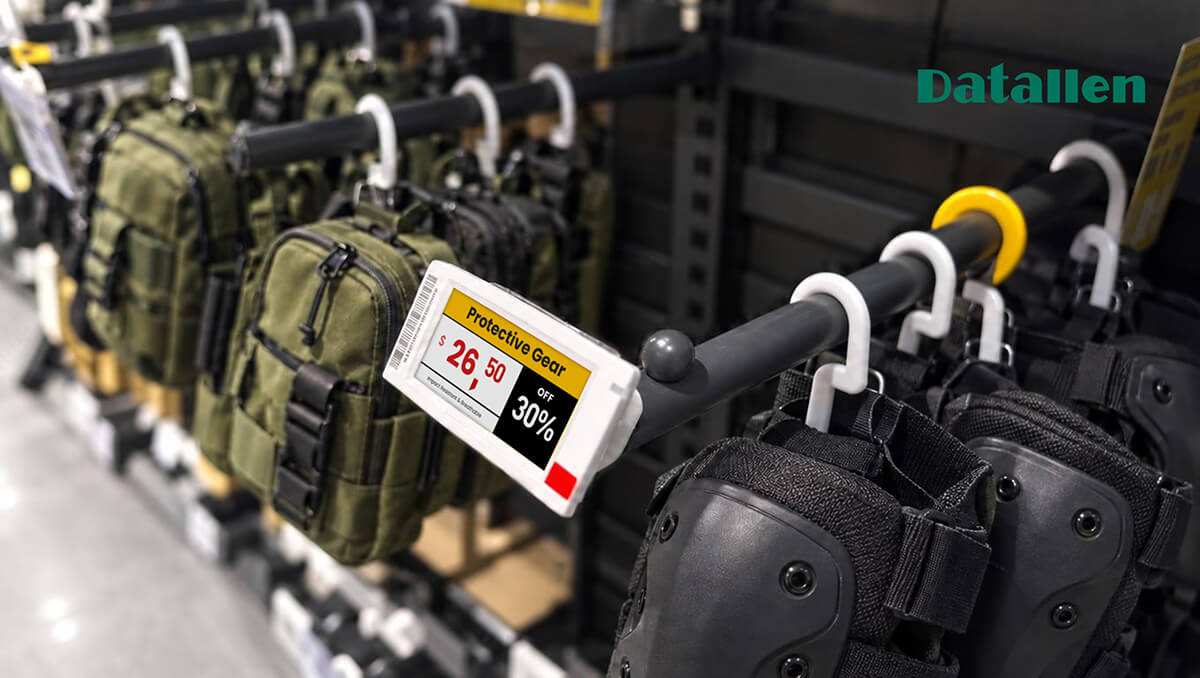
Make Model Variations Easy to Identify
Once customers reach the right category, they need to distinguish between individual models and versions.
A practical approach is to use consistent product identification across the showroom. Each display position should clearly connect the bicycle to its model name, frame size, color, and relevant configuration. Where several versions are displayed together, the information should make their differences immediately recognizable.
This is particularly useful when a store sells multiple generations of the same model. Similar-looking bicycles may have different component specifications or prices, so relying on appearance alone can lead to misunderstandings.
Retailers should also consider what happens when a display bike is moved, sold, or replaced. Its product label needs to move with it or be updated accordingly. A well-organized display system should make this process straightforward for employees.
Balance Bike Displays with Customer Movement
Bicycles require considerably more floor space than most packaged retail products. Customers may want to walk around a bike, inspect its frame, check the handlebars, or sit on it with assistance from a salesperson.
For this reason, the showroom needs enough clearance between display positions and around key service areas. Narrow passages can make it difficult to move bicycles safely, especially during busy periods.
The service department also deserves careful consideration. Bikes waiting for repairs, completed service orders, and new retail products should not compete for the same space. A clearly defined route between the service entrance, workshop, and storage area can prevent unnecessary congestion.
Retailers should periodically observe how customers and employees move through the shop. If people frequently stop in front of a narrow aisle or service counter, the problem may be the layout rather than the number of products on display.
The National Bicycle Dealers Association recommends examining customer movement and identifying bottlenecks when evaluating store design. These observations can help retailers improve both the shopping experience and daily operations.
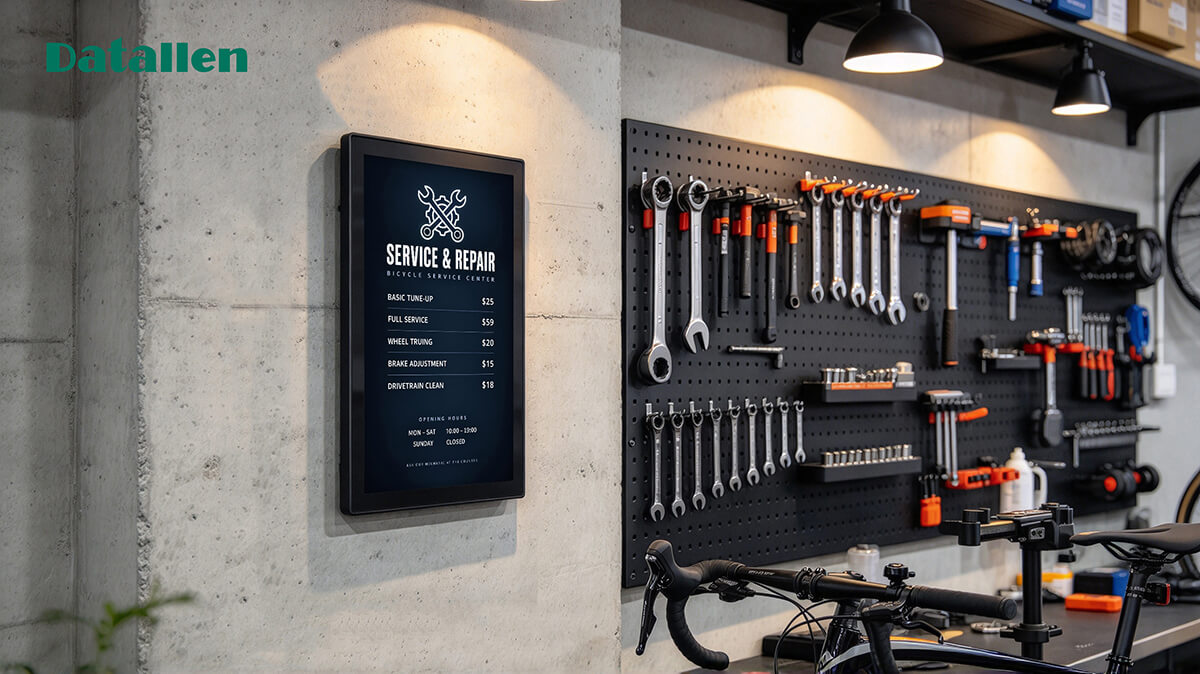
Make Bicycle Specifications Easier to Compare with Electronic Shelf Labels
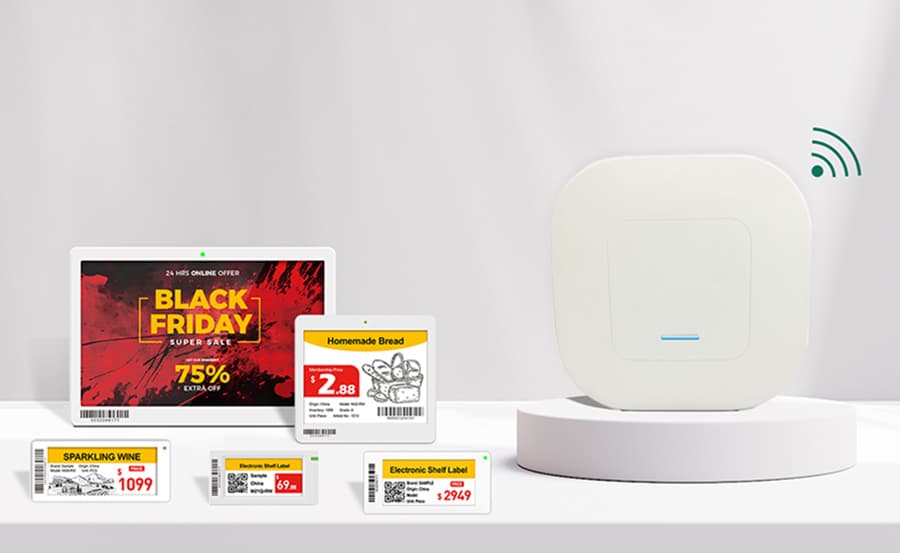
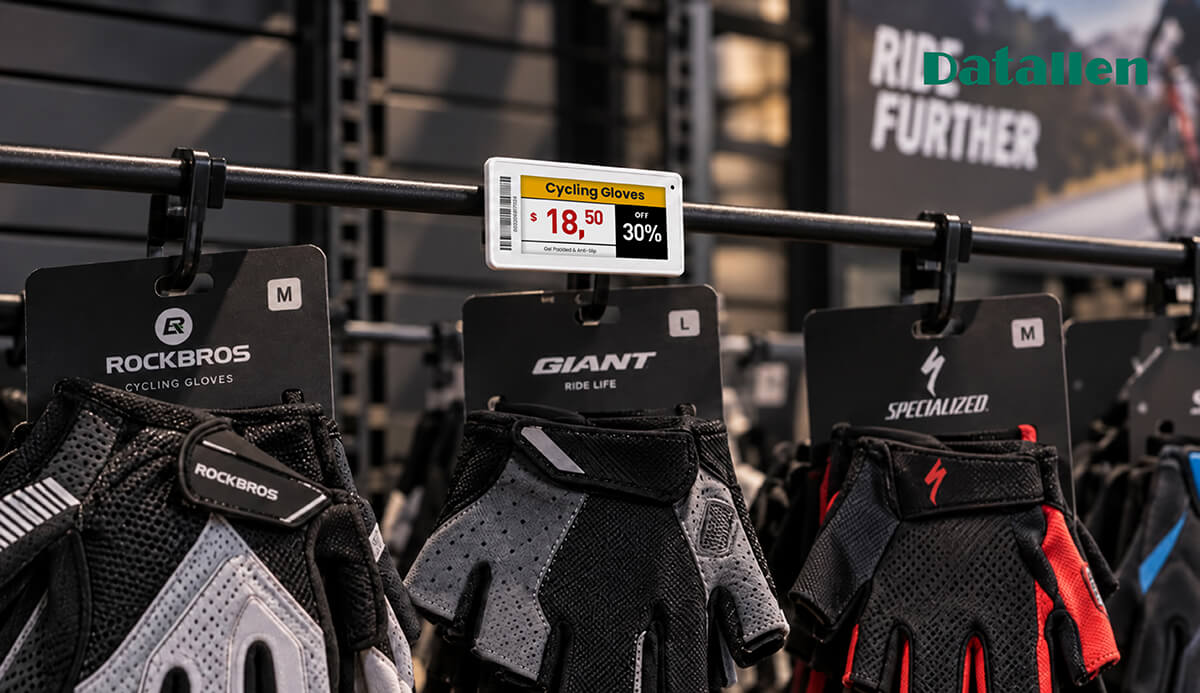
Electronic shelf labels (ESLs) offer a practical way to present prices and essential product information across bicycle displays and accessory shelves. Their value in a bike shop goes beyond replacing paper price tags. When properly planned, they can help retailers maintain clearer product identification across numerous models and variations.
Match Each Price Tag to the Exact Bicycle Version
One of the most important considerations in bicycle retail is ensuring that the displayed information matches the actual product.
Consider a shop displaying three versions of the same mountain bike. They may share a similar frame design but differ in size, drivetrain, suspension components, or price. If the labels only show the model family and a price, customers may struggle to identify which version they are looking at.
An ESL template can be designed to display the most relevant identifying details, such as:
Bicycle model and version.
Frame size.
Color or configuration.
Key component information.
Current selling price.
For accessories, the information can be adjusted to suit the product. A helmet label may focus on model, size, and price, while a cycling computer display may highlight its main features and product version.
The key is to create category-specific templates rather than force every product into the same information layout.
What Information Should an Electronic Shelf Label Display?
Not every bicycle needs a long list of technical specifications beside it. Small electronic displays have limited space, and too much information can make them harder to read.
A more effective approach is to prioritize the specifications that help customers distinguish between products.
| Product Category | Recommended Display Information |
|---|---|
| Road Bikes | Model, frame size, groupset, price |
| Mountain Bikes | Model, wheel size, suspension type, price |
| Gravel Bikes | Model, frame material, tire clearance, price |
| E-Bikes | Motor type, battery capacity, price |
| Helmets | Model, size, price |
| Cycling Apparel | Product name, size, color, price |
| Bike Components | Model, compatibility, price |
These are suggested information fields, not mandatory specifications for every product. Retailers should select details based on the products they sell and the questions customers most frequently ask.
For example, a QR code can provide access to a more detailed product page, where shoppers can review full specifications, sizing information, or manufacturer documentation. This keeps the physical label readable while making additional information available when needed.
Keep Prices and Product Variants Consistent During Model Changes
Bicycle retailers regularly deal with new product releases, previous model-year inventory, and clearance promotions. These changes can make price and product identification more complicated.
A previous-year model may look almost identical to its replacement, yet have a different groupset or component configuration. If both are displayed in the same area, outdated paper labels can easily confuse.
Electronic shelf labels allow authorized employees to update displayed information through a connected management system, subject to the store's software configuration. Multiple labels can be updated in batches instead of requiring staff to print and replace each paper tag individually.
For multi-location retailers, centralized management can also help maintain consistent product information and pricing policies across branches. However, the accuracy of the displayed information still depends on correct product data, SKU mapping, and integration with the retailer's existing systems.
An ESL is a display device, not a pricing decision-maker. The actual price must come from the retailer's authorized pricing system, with the appropriate process for synchronizing the displayed price and checkout system.
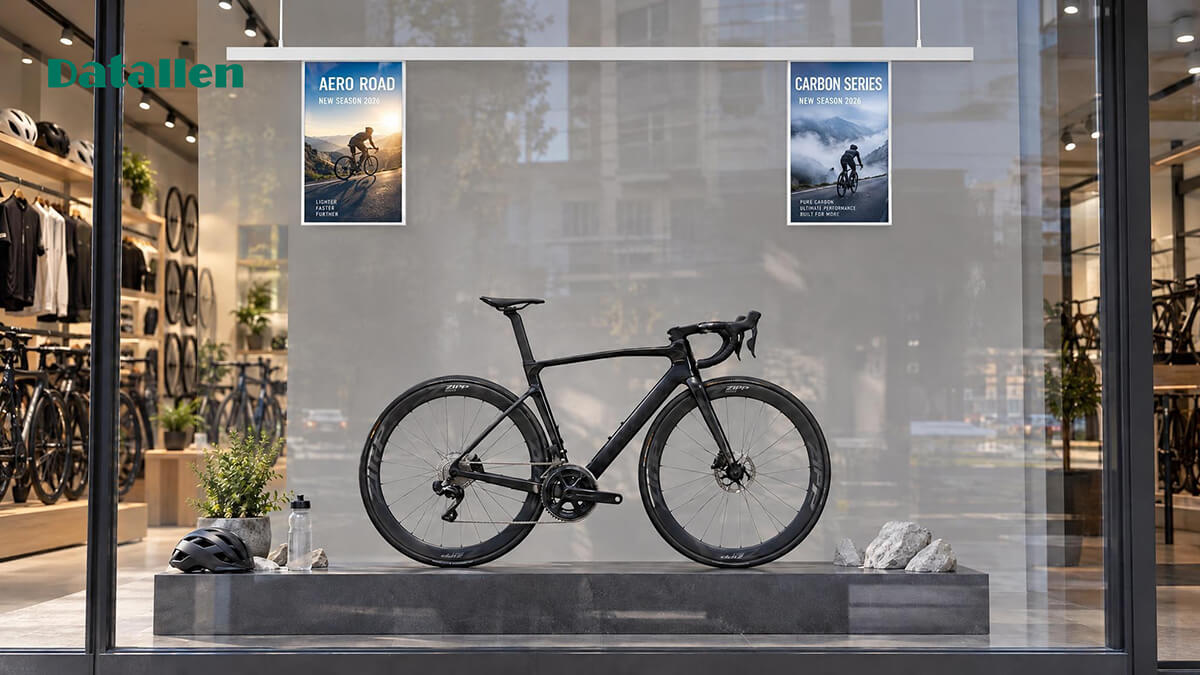
Beyond Static Displays: Using Digital Signage to Explain and Promote Bicycle Products
While electronic shelf labels help customers identify individual products, some bicycle features are much easier to understand through visual demonstrations. LCD digital signage gives retailers another way to communicate product information, introduce new models, and create more engaging showroom displays.
Rather than showing the same promotional message throughout the store, retailers can tailor content to the products and customers in each area.
Demonstrate What Product Specifications Cannot Fully Explain
A list of specifications can tell customers what a bicycle has, but it cannot always show how those features work or why they matter.
For example, a short video can demonstrate how a suspension system responds to uneven terrain, show the details of a bicycle frame, or introduce the riding characteristics of a gravel bike. For an electric bicycle, visual content can help explain the motor system, assistance modes, and everyday riding applications.
These demonstrations are particularly useful for customers who are new to cycling and may not understand technical terminology. Instead of presenting a long list of unfamiliar specifications, retailers can use clear visuals to make product features easier to understand.
Tell the Story Behind Each Bicycle Category
Different types of bicycles appeal to different riding interests. Digital signage can help communicate these differences through content that reflects how each category is used.
For example:
Road Bikes: Show road cycling, training, group rides, and long-distance journeys.
Mountain Bikes: Feature trail riding, technical terrain, and suspension performance.
Gravel Bikes: Present mixed-surface routes and longer outdoor adventures.
Commuter Bikes: Highlight daily transportation, urban convenience, and practical accessories.
E-Bikes: Demonstrate assisted riding for commuting, leisure, and longer journeys.
This approach gives customers a better sense of the riding experience associated with each category. It also helps retailers present the benefits of a product without relying entirely on sales staff to explain every detail.
Use Digital Advertising Displays for Seasonal and Product Campaigns
Bicycle purchasing patterns are often influenced by weather, local riding conditions, and seasonal activities. A campaign that works well during the spring cycling season may not be relevant during colder months.
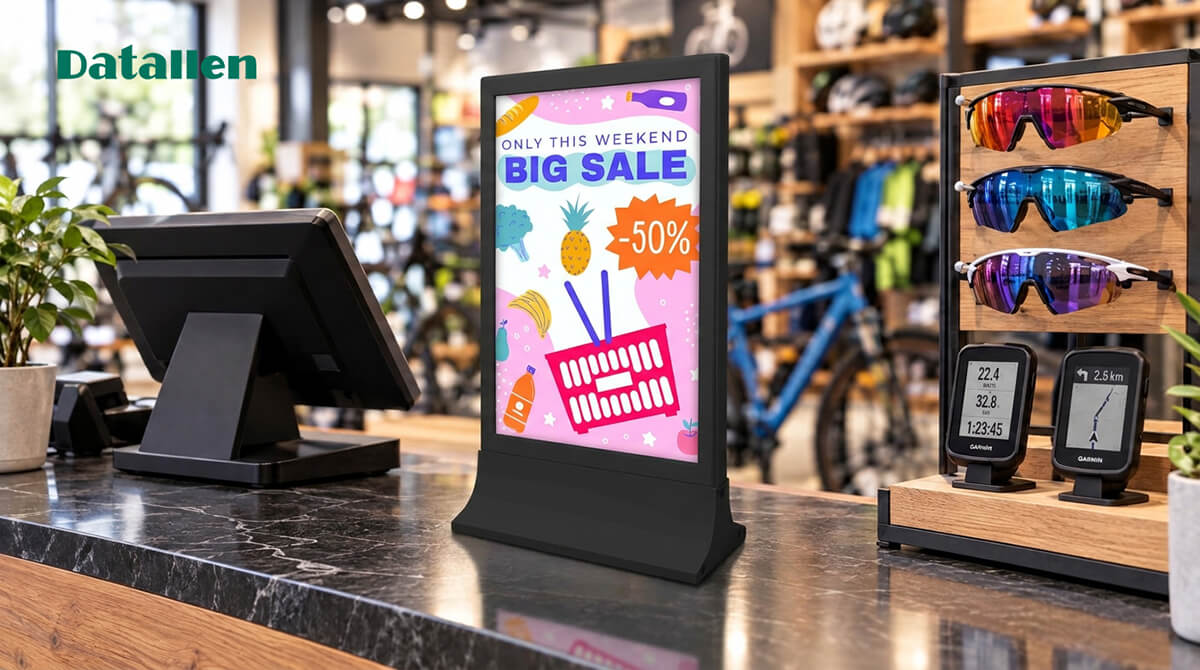
LCD digital advertising displays allow retailers to change promotional content as these needs evolve. A store might highlight new road bike arrivals in spring, cycling apparel and hydration products during summer, or maintenance accessories before the winter season.
They can also be used to promote:
New bicycle collections and product launches.
Brand campaigns and cycling events.
Special offers on previous model-year bikes.
Helmet and protective equipment promotions.
Local group rides, workshops, and store activities.
The content should match the location of the screen. A display near the e-bike section, for example, is more useful when it shows electric bicycle products and related information than when it runs an unrelated general promotion.
Choose Screen Sizes and Installation Positions Carefully
The best screen placement depends on viewing distance, available space, and the purpose of the content.
Compact desktop displays can work well on counters or product presentation tables. Wall-mounted screens are suitable for brand areas and product information zones, while ceiling-suspended displays can be useful where floor space is limited, and customers need to see promotional content from a distance.
Retailers should also consider lighting, power access, cable management, and whether a screen could obstruct the view of the actual bicycles. A digital display should support the product presentation rather than compete with it.
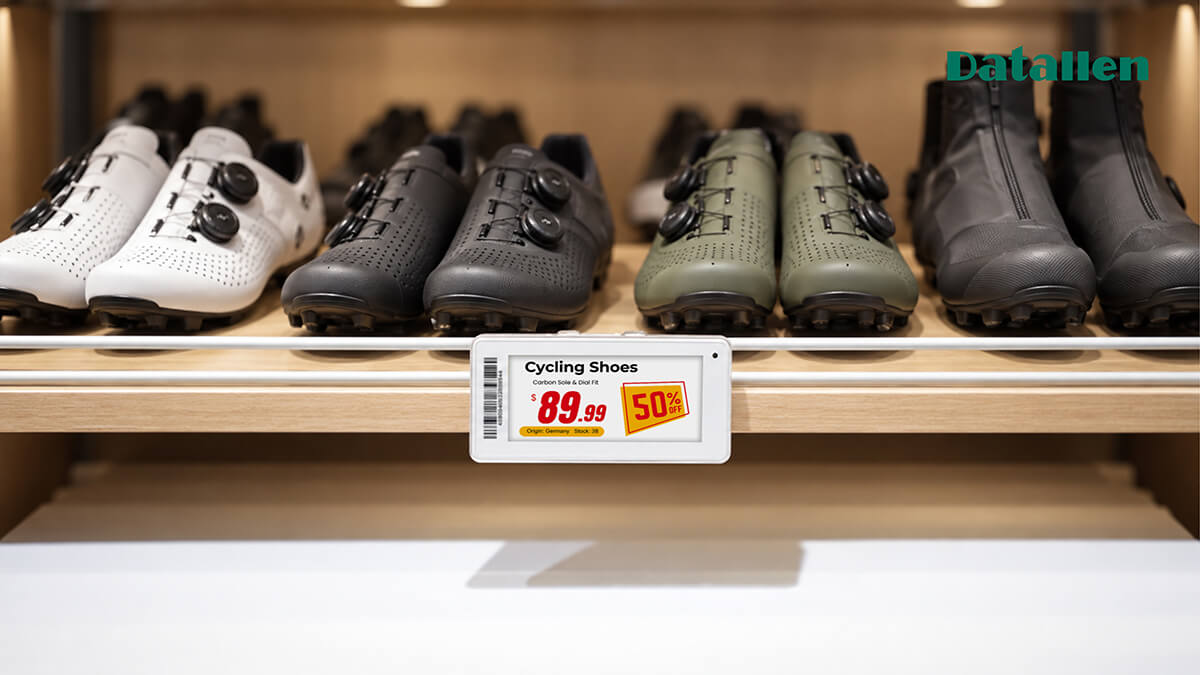
Connect the Display with the Entire Bicycle Shopping Journey
A bicycle purchase rarely happens in a single step. Customers may first browse different categories, compare specifications, discuss their riding needs with staff, check their size, and arrange a test ride.
This creates an opportunity to connect physical product displays with the different stages of the shopping journey.
From Browsing to Bike Fitting
Finding the right bicycle involves more than choosing a model based on appearance or price. Frame size, riding position, body proportions, and intended use all influence whether a bicycle is suitable.
A well-organized showroom can help customers narrow down their options before speaking with a specialist. Clear model identification and accessible specifications make it easier to discuss suitable bicycles.
The next step is professional bike fitting. Depending on the store's process, this may involve measuring the rider, assessing frame size, adjusting saddle height, and comparing different models or sizes.
Digital displays can introduce basic sizing concepts or explain the fitting process, but they should never replace individual assessment by trained staff. Frame size recommendations are starting points, not universal guarantees of fit.
For retailers, this distinction matters. Product information should help customers ask better questions and prepare for a more useful consultation.
Turn Accessory Displays into Useful Buying Guidance
Accessories offer another important opportunity for bicycle retailers. However, simply placing helmets, gloves, lights, and bags on nearby shelves does not always help customers understand which products they need.
A more useful approach is to organize accessories around riding activities and practical requirements.
| Riding Type | Related Accessories |
|---|---|
| Road Cycling | Road helmets, cycling jerseys, shoes, sunglasses |
| Mountain Biking | Protective gear, gloves, hydration packs |
| Urban Commuting | Bike locks, lights, pannier bags |
| Touring | Panniers, repair kits, portable pumps |
| E-Bike Riding | Compatible chargers, locks, storage accessories |
This approach can make accessory shopping more intuitive. It also gives retailers opportunities to introduce complementary products through category signage and promotional content.
Compatibility should remain a priority. Not every component, charger, or accessory works with every bicycle. Product recommendations should be based on verified specifications rather than visual similarity or broad category labels.
Special Display Considerations for E-Bike Retailers
Electric bicycles deserve particular attention because their technical features often require more explanation than those of conventional bicycles.
For retailers selling multiple e-bike brands and models, a dedicated display strategy can make it easier for customers to compare options without confusing battery specifications, motor systems, or estimated riding distances.
Present Battery and Range Information Responsibly
Battery capacity, usually expressed in watt-hours (Wh), is one of the first specifications customers may compare. However, two electric bicycles with similar battery capacities do not necessarily deliver the same riding range.
Motor efficiency, assistance settings, rider weight, terrain, temperature, wind, and tire pressure can all affect energy consumption.
Retailers should therefore distinguish between battery capacity and estimated range. If manufacturers provide range estimates, the relevant conditions should be made clear. Avoid presenting a single maximum distance as something every rider can expect.
Explain the Differences Between E-Bike Models
A dedicated e-bike display area can help customers compare important features, including:
Hub-drive and mid-drive motor systems.
Battery capacity and charging arrangements.
Pedal-assistance modes.
Frame design and intended riding use.
Carrying capacity and available accessories.
The aim is to make technical information easier to understand, not to overwhelm customers with engineering terminology.
For example, a commuter may care more about everyday practicality, carrying capacity, and charging convenience, while a mountain bike customer may focus on motor assistance, battery capacity, and performance on climbs.
Keep Safety and Compliance Information Accessible
Electric bicycle retailers should also make manufacturer instructions and relevant safety information easy to access.
Battery charging, storage, transportation, and maintenance requirements should follow the manufacturer's guidance. Applicable e-bike classifications and local regulations should also be considered, particularly where speed limits, motor output, or permitted usage differ between markets.
A screen or product information display can direct customers to relevant guidance, but it should not replace official manuals or legal information.
Managing Seasonal Stock and Multiple Bike Stores
Bicycle retail inventory changes throughout the year. New collections arrive, older models remain in stock, and certain sizes or colors may sell faster than others. These changes create challenges for both product identification and promotional planning.
Adapt Displays to Seasonal Buying Patterns
Seasonal merchandising should reflect local cycling habits rather than follow a fixed calendar.
In warmer markets, cycling activity may remain high throughout the year, while regions with cold winters may experience more noticeable seasonal changes.
Retailers can adjust their product presentation according to local demand:
Spring: New bicycle models, helmets, and cycling apparel.
Summer: Hydration products, sunglasses, lights, and touring accessories.
Autumn: Commuting equipment, protective clothing, and maintenance products.
Winter: Indoor training equipment, maintenance supplies, and cold-weather cycling gear.
Digital signage makes it easier to change campaign content without repeatedly printing new promotional materials. The most effective approach is to align the message with products that are actually available in the store.
Maintain Consistency Across Multiple Stores
For bicycle chains and multi-location retailers, maintaining consistent product information becomes more complicated as the number of stores increases.
A central team may want to standardize brand campaigns, product templates, and promotional materials, while individual stores need flexibility to reflect their own inventory and local offers.
A suitable digital management setup should support both requirements. Centralized templates can maintain a consistent brand presentation, while authorized local updates can account for differences in available models, sizes, and stock.
This is particularly useful when one branch has several sizes of a new model while another is mainly selling previous-year inventory. The information shown at each location should reflect its actual products rather than simply repeat a company-wide promotion.
Building an Integrated Bicycle Retail Store Display Solution with Datallen
A well-planned bicycle showroom needs display tools that suit different product categories and operational requirements. Datallen, a SUNLUX sub-brand, offers electronic shelf labels and LCD digital signage for retail applications.
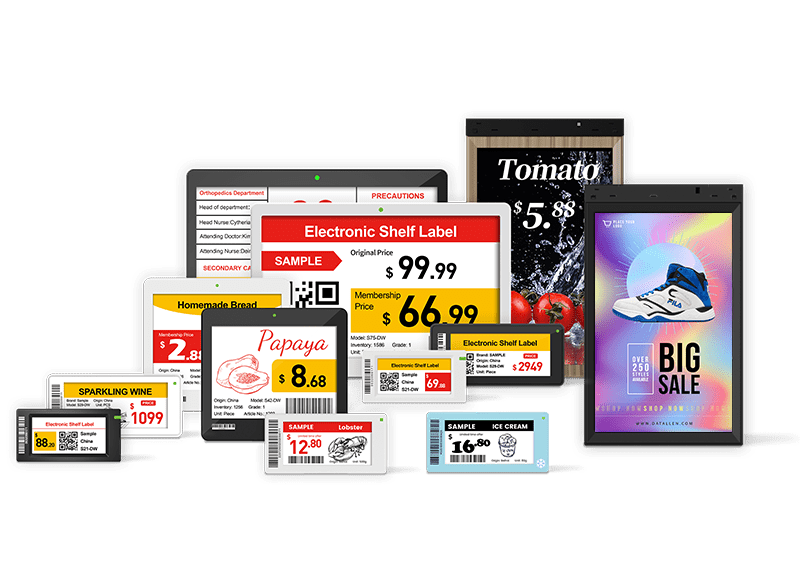
Its ESL solutions support multiple display sizes, customizable templates, multilingual content, and bulk information updates, helping bicycle retailers manage prices and product details across different models and accessories. Datallen LCD digital signage is available in different screen sizes and installation formats for showcasing bicycle features, brand content, cycling videos, and promotional campaigns. Content can be updated through computers or mobile devices, making it easier for retailers to manage in-store displays.
Whether you operate a specialist bike shop or a multi-location bicycle retail business, the right combination of electronic shelf labels and digital signage should reflect your product range, store layout, and daily management needs. Contact Datallen to discuss a display solution tailored to your bicycle retail business.
FAQ About Bicycle Retail Store Displays
1. What Product Information Should Be Displayed for Electric Bikes?
Important details include battery capacity in Wh, motor type, assistance modes, and the intended riding application. If an estimated range is shown, explain that actual distance depends on riding conditions, rider weight, terrain, and assistance settings. Customers should also have access to manufacturer charging and maintenance guidance.
2. How Can Bike Shops Make It Easier for Customers to Compare Different Bicycle Models?
Group bicycles by riding purpose and provide consistent information about their key specifications. Highlight the differences that matter most within each category, such as frame material, drivetrain, suspension, or motor system. Clear product identification helps customers narrow their choices before discussing detailed requirements with sales staff.
3. Can Digital Displays Help Promote Cycling Accessories Alongside Bicycles?
Yes. Retailers can create category-specific content showing accessories related to different riding activities, such as helmets for road cycling or locks and lights for commuting. Product compatibility should always be checked before making recommendations, especially for components, chargers, and model-specific accessories.
4. How Can Multi-Location Bicycle Retailers Keep Store Displays Consistent?
A centralized content management approach can help standardize product templates, brand campaigns, and promotional materials. Individual stores should still be able to update local product information and offers according to their actual inventory. System integration and access permissions should be planned before deployment.
For more insights, check out:
1. Top 10 Digital Signage Manufacturers to Consider in 2026 And How to Choose
2. Elevator Digital Signage: How to Turn Every Elevator Ride into a Smart Communication Channel
3. Datallen | Digital Signage Costs 2025: Buying & Installation Guide
4. How to Select Among Various Types of Digital Signage
5. How Much Will Electronic Shelf Labels Cost Your Business? What You Should Expect to Pay in 2025