Introduction: The Display Technology That Thinks Like Paper
For decades, the display industry has been defined by a simple trade-off: brighter, more vibrant screens required more power. LCDs and OLEDs deliver stunning visuals but consume energy continuously, generate heat, and struggle in direct sunlight. Then there is the color epaper display—a technology that fundamentally breaks this trade-off.
The numbers tell a compelling story. The global E-Paper Display market was valued at USD 7.2 billion in 2025 and is projected to reach USD 53.2 billion by 2033, growing at a compound annual growth rate of 28.4%. Within this broader market, color e-paper electrophoretic displays for retail electronic shelf labels (ESL) alone reached $0.5 billion in 2025 and are expected to expand to $2.8 billion by 2034.
But what exactly is a color epaper display? How does it work, and why are retailers, logistics providers, and digital signage operators increasingly adopting it? This guide provides a comprehensive, practical overview—covering the technology, applications, costs, and real-world considerations that matter most to decision-makers.
How Color E-Paper Display Technology Works
The Foundation: Electrophoretic Display
To understand color epaper, you must first understand the underlying principle: electrophoretic display (EPD). Unlike LCDs that use backlights to illuminate pixels, epaper display technology uses microscopic pigment particles suspended in a fluid.
In a monochrome EPD, positively charged white particles and negatively charged black particles sit within microcapsules. When an electric field is applied, the appropriate particles rise to the surface—creating the appearance of white "paper" or black "ink." Once the image is formed, the display requires zero power to maintain it. This is called bistability, and it is the single most important differentiator between e-paper and every other display technology.
From Black-and-White to Full Color
Color epaper builds on this foundation through two primary approaches:
Color Filter Array (CFA) — This method laminates a color filter film onto a grayscale electrophoretic display. Each pixel's grayscale level is filtered through red, green, or blue sub-pixels to create color. CFA-based color epaper display offers faster refresh rates than other color e-paper technologies but has a narrower color gamut—16 grayscale levels per pixel compared to 256 levels per RGB component in LCDs. Recent deep learning approaches have significantly improved color fidelity, achieving a peak signal-to-noise ratio of 24.33 dB with 75-fold speed improvement over traditional dithering methods.
Multi-Pigment Microcapsule — This more advanced approach places multiple colored pigments (red, yellow, blue, and white) within each microcapsule. When an electrical signal is applied, designated particles rise to the surface, producing colors in a process that closely resembles printing ink on paper. Samsung's 32-inch Color E-Paper, for example, uses this method to reproduce up to 2.5 million hues with just six base colors, achieving a 40-fold improvement in color richness over conventional e-paper solutions.
The Three Main Color E-Paper Technologies
For those evaluating types of digital tags and displays, understanding the three major color e-paper technologies is essential:
E Ink Kaleido — Uses a color filter array on top of a monochrome display. Currently at Kaleido™ 3, it supports 4,096 colors and offers faster refresh rates suitable for e-readers and general signage. Refresh times are fast enough for everyday user interface interactions and page turns.
E Ink Spectra — Designed specifically for retail signage and ESL applications. Spectra™ 6 delivers highly saturated color and paper-like readability without requiring a color filter. It offers up to 200 PPI resolution and 30:1 contrast ratio, but refresh rates are slower—approximately 12 seconds for a full refresh.
E Ink Advanced Color e-Paper (ACeP) — The premium full-color solution that produces colors without a color filter array, using colored particles directly. It delivers superior color saturation but with slower refresh rates, making it ideal for static signage rather than interactive applications.
Color E-Paper Display vs. LCD: Understanding the Real Differences
When comparing a color epaper display to an LCD, the differences go far beyond spec sheets:
Power Consumption — This is where e-paper wins decisively. An LCD uses a strong backlight that must remain powered continuously. A color epaper display, by contrast, consumes power only when updating content. Once a static image is formed, power consumption falls to less than 0.005 watts—effectively zero. Samsung's Color E-Paper draws 0.00W while displaying a static image, allowing months of operation on battery power alone.
Readability — E-paper displays reflect ambient light exactly like printed paper and emit no blue light. This makes them significantly less tiring on the eyes than LCD screens and exceptionally readable in direct sunlight—conditions where LCDs wash out or require maximum backlight power. Printed signs are replaced week after week, while full LCD signage demands constant power; color epaper sits in between—legible, calm, and visually consistent under ambient lighting.
Refresh Rate — This is the trade-off. Black-and-white e-paper displays can complete a full refresh in about 2 seconds; multicolor displays typically take 5-10 seconds. Spectra 6 panels refresh in approximately 12 seconds. This means color epaper display technology is fundamentally suited for static or slowly changing content—not video or fast animations.
Color Vibrancy — LCDs still produce more vibrant, saturated colors. However, the gap is narrowing. E Ink's Spectra 6 panels deliver color reproduction that approaches LCD quality. The question is no longer "can color e-paper match LCD?" but rather "does it need to?" For price tags, wayfinding, menu boards, and promotional signage, the answer is increasingly no.
The Retail Revolution: Color E-Paper in Electronic Shelf Labels
Market Momentum
The electronic shelf label market is experiencing explosive growth. Valued at USD 2.66 billion in 2025, it is projected to reach USD 8.45 billion by 2034, growing at a CAGR of 13.70%. The broader ESL market, according to Future Market Insights, is projected to expand from $2.17 billion in 2025 to $10.8 billion by 2035.
Within this market, color epaper is the fastest-growing segment. The global full-color electronic shelf labels market was valued at $187 million in 2025 and is forecast to reach $506 million by 2032. Color e-paper and quad-color e-paper are accelerating their market penetration in ESL applications.
Why Color Matters for ESL
Black-and-white ESL tags served their purpose: they displayed prices clearly and eliminated manual pricing errors. But they could not convey promotional urgency, highlight sale items, or reinforce brand identity at the shelf edge.
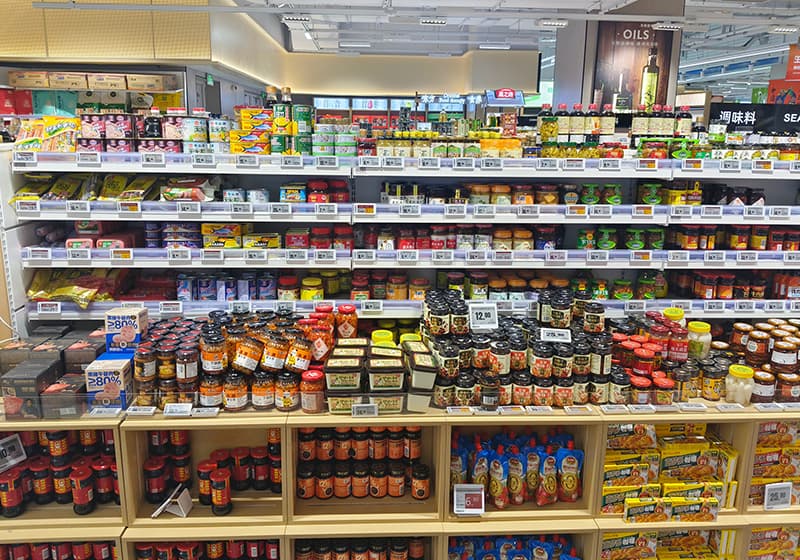
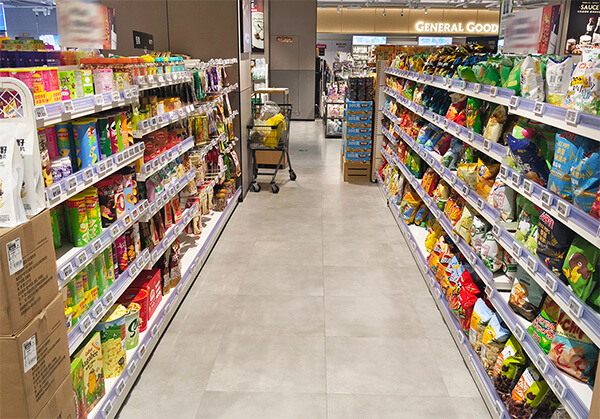
Color ESL tags—capable of rendering four or more distinct hues including vivid red, yellow, and green on a white background—allow retailers to encode promotional urgency, dietary attributes, and brand identity directly into shelf-edge communication. A red border around a price signals a sale. A yellow background highlights a new product. Green communicates organic or sustainable attributes.
Real-World Impact
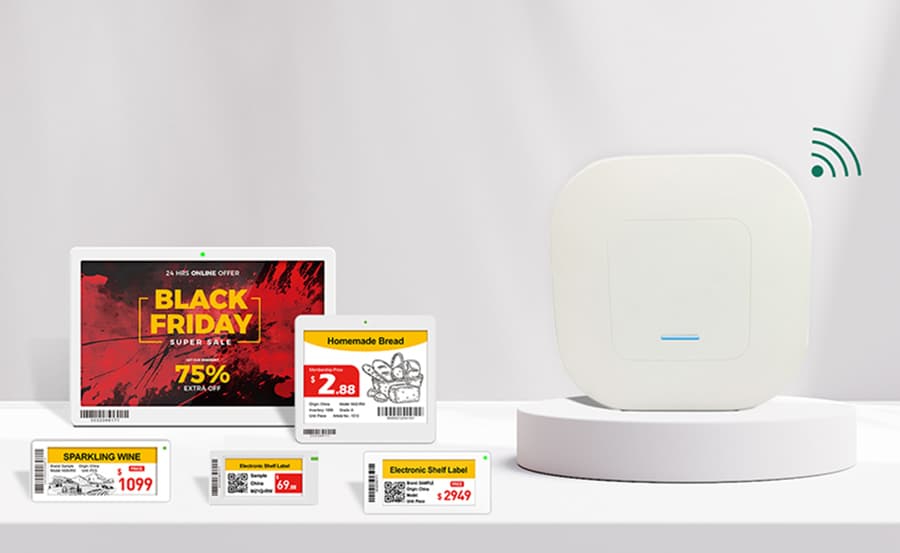
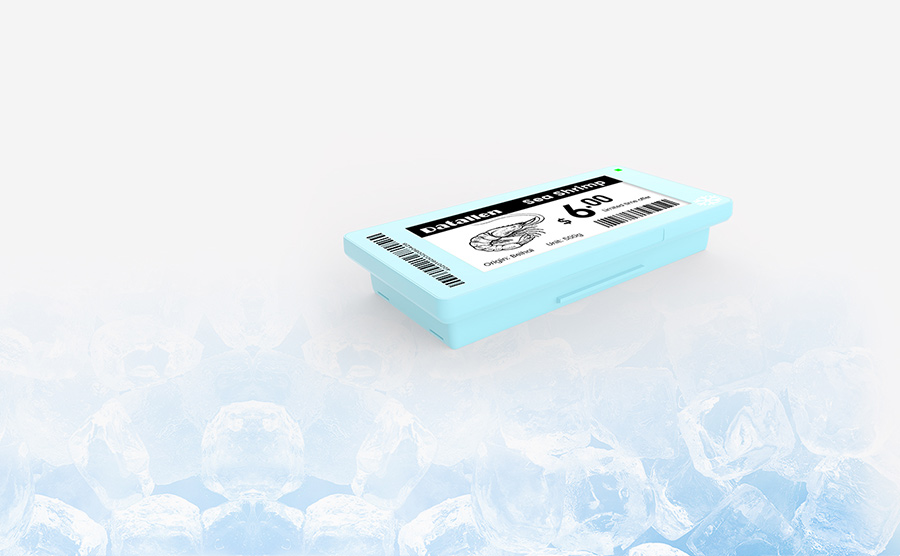
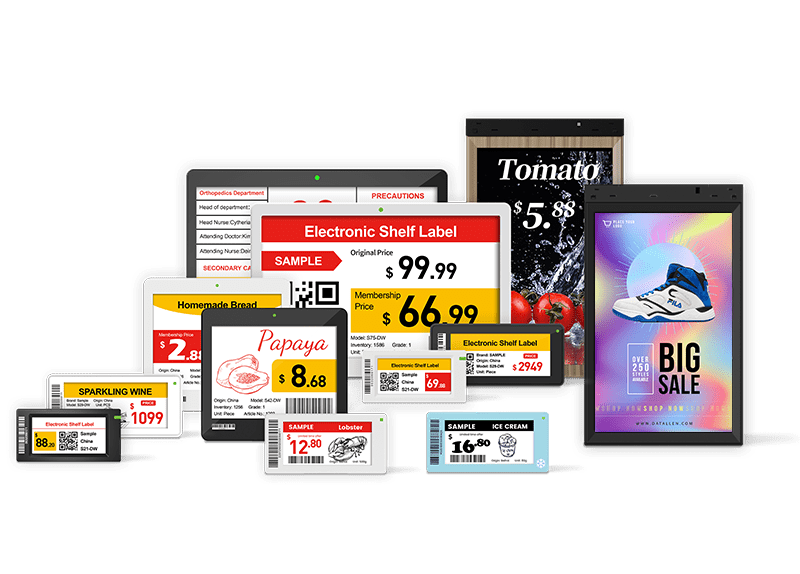
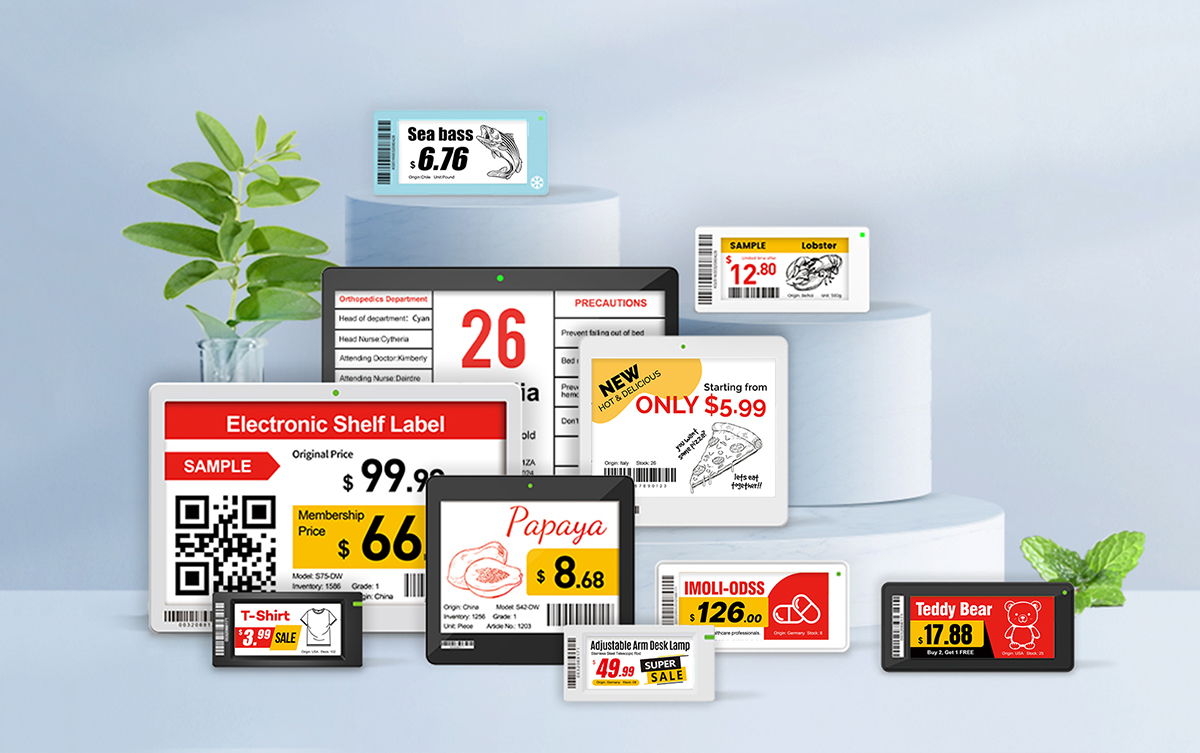
Datallen, a provider of electronic shelf label solutions, has deployed four-color e-paper ESLs across diverse retail environments. These labels offer high contrast, ultra-low power consumption, and multi-color display options (black, white, red, and yellow) to emphasize promotions and attract customer attention. With ultra-low power consumption enabling up to five years of battery life, these solutions are designed for scalable and cost-effective retail operations.
The operational benefits are tangible. Prices can be updated instantly and accurately, eliminating the manual labor and pricing discrepancies associated with paper tags. Built-in support for QR codes and barcodes enables interactive marketing, connecting online and offline shopping experiences.
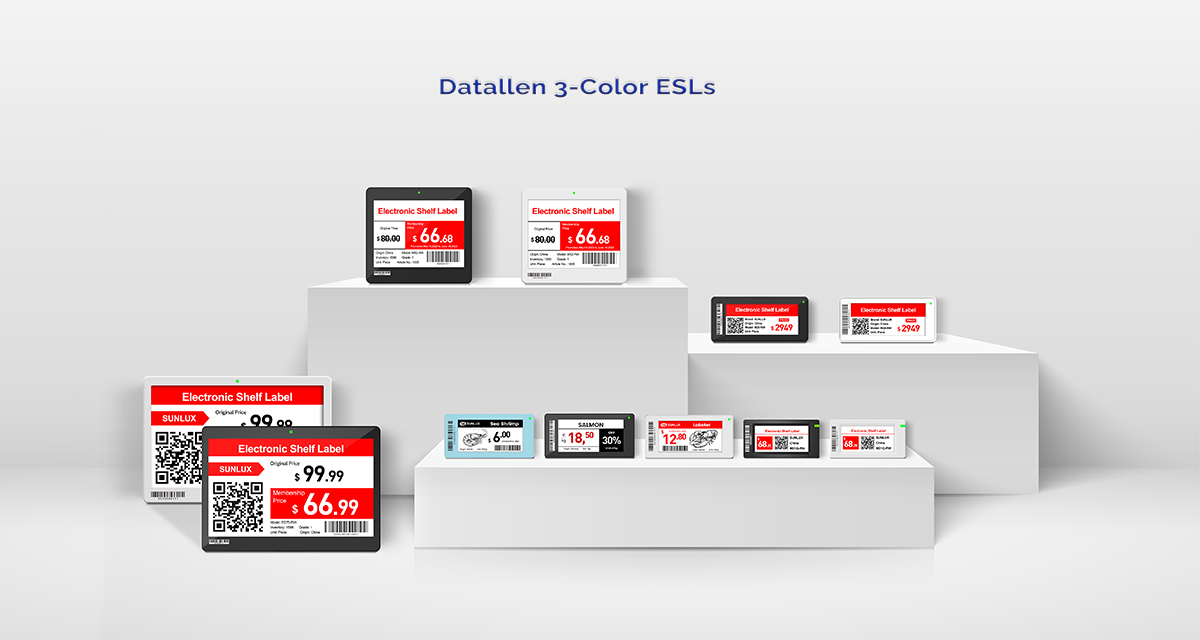
The Maturation of 3-Color and 4-Color ESL Technology
While full-color e-paper captures headlines, the real workhorse of today's retail ESL market remains the 3-color and 4-color epaper display solutions. These technologies—typically rendering black, white, and red (3-color) or black, white, red, and yellow (4-color)—have reached a level of technical maturity and cost efficiency that makes them the default choice for the vast majority of retail deployments.
Significant cost reductions have marked the journey from early adoption to mainstream acceptance. Basic electronic shelf label models dropped below $8 per unit in September 2025—a 60% reduction from 2023 levels. More importantly for retailers evaluating types of digital tags, the cost gap between 3-color and 4-color ESLs has narrowed substantially. Industry sources indicate that 4-color labels now carry costs comparable to their 3-color predecessors, making the upgrade to four-color a compelling value proposition rather than a premium investment.
This cost parity is accelerating a strategic shift across the ESL industry. Major ESL providers are moving exclusively to 4-color and multi-color display labels, phasing out production of legacy 3-color models entirely. The rationale is straightforward: with 4-color labels offering black, white, red, and yellow—adding yellow's high-visibility impact for “New,” “Bestseller,” or “Manager's Special” cues—retailers gain a richer visual communication toolkit at minimal incremental cost.
The operational benefits are equally compelling. A 4-color color epaper ESL enables retailers to encode promotional urgency, dietary attributes, and inventory signals directly into shelf-edge communication—all while maintaining the ultra-low power consumption and paper-like readability that define e-paper technology. With battery lives reaching up to five years and wireless bulk update capabilities supporting thousands of labels simultaneously, these solutions have transformed from experimental technology to reliable retail infrastructure.
For the majority of retailers today, the question is no longer whether to adopt color ESLs, but which color configuration delivers the optimal balance of visual impact and cost—and increasingly, the answer is four-color.
Walmart's ESL Rollout: A Testament to Technology Maturity
Perhaps no single deployment better illustrates the coming of age of color e-paper display technology than Walmart’s ambitious chain-wide ESL rollout. The world's largest retailer began piloting digital shelf labels in 2024 at a store in Grapevine, Texas, and has since accelerated deployment at an unprecedented scale.
By early 2026, approximately 2,300 Walmart U.S. locations—roughly half of its more than 4,600 domestic stores—were already equipped with digital shelf labels. The company expects the technology to be installed chain-wide by the end of 2026, representing one of the largest ESL deployments in retail history. Industry estimates place Walmart's total ESL demand between 400 million and 500 million units, with 150 million units shipped by the end of 2024 and an additional 300 million or more projected through 2026. The total project carries an estimated price tag of approximately $1 billion.
The impact on the broader ESL market has been transformative. Global ESL shipments surged from just over 100 million units per quarter to nearly 200 million units in the second quarter of 2025. The first half of 2025 saw ESL module shipments reach 324 million units—a staggering 244.4% increase year-over-year. Market analysts attribute this growth primarily to Walmart's large-scale adoption, which began in mid-2024 and created a ripple effect across the industry.
Walmart's deployment is about far more than scale—it demonstrates the tangible operational value of esl tags. With paper labels, updating prices across a single store required two days of manual labor. With ESLs, prices can be updated across the entire store within minutes. This efficiency gain frees employees from repetitive price-changing tasks to focus on customer service and higher-value activities. Beyond pricing, Walmart’s ESLs feature LED flashing capabilities that streamline inventory management—guiding employees to restock locations and accelerating online order fulfillment.
The deployment also signals a broader industry validation. When the world's largest retailer commits to a technology at this scale, it sends a clear message to suppliers, competitors, and investors: electronic shelf labels are no longer experimental—they are the new standard. As one industry observer noted, Walmart's move is primarily about improving efficiency and reducing costs—manual price changes across thousands of stores represent a massive operational burden that automation can eliminate.
For retailers still evaluating whether to transition from paper to electronic labels, Walmart’s deployment offers a compelling proof point. The technology is proven at scale. The operational benefits are quantifiable. And the market momentum—driven by the industry's largest player—suggests that the era of paper price tags is drawing to a close.
Cost Considerations: What You Really Pay For
The Price Gap
Color epaper display technology commands a premium. Color displays typically cost 1.5× to 3× more than their monochrome equivalents across every size class. A 13.3-inch Kaleido 3 color module retails for $449 from E Ink's official shop—and that is just the panel.
Compared to LCDs, the gap is even larger. Color e-paper displays currently cost 8-10 times more than LCD monitors of the same general size. This has been a significant barrier to adoption, particularly for large-format digital signage.
The Total Cost of Ownership (TCO) Perspective
However, focusing solely on upfront cost misses the bigger picture. The total cost of ownership for color epaper solutions often compares favorably to alternatives:
Energy Savings — LCD digital signage requires continuous power. During content updates, color e-paper still uses significantly less energy than LCD digital signage, reducing operational costs. For battery-powered ESL deployments, the energy savings translate directly into longer battery life and reduced maintenance costs.
Labor Savings — Manual price tag updates are labor-intensive and error-prone. The electronic shelf label market's growth is driven in large part by retailers' need to eliminate these costs.
Paper Elimination — For retailers replacing printed promotional signage, the savings on paper, printing, and distribution can be substantial.
The Future of Pricing
E Ink has declared 2025 the "first year of large-format e-paper," signaling a strategic shift toward price competitiveness with LCDs. The company aims to sell large-format color e-paper panels at prices competitive with LCDs, targeting e-readers and digital notepads. As manufacturing scales and technology matures, the cost gap is expected to narrow significantly.
Frequently Asked Questions About Color E-Paper Display
Can color e-paper display video?
No. Color e-paper technology is fundamentally designed for static or slowly refreshing content. Refresh rates range from 5-12 seconds for full-color updates. While recent advancements—such as E Ink's T2000 chip enabling video playback on 75-inch color e-paper—are pushing boundaries, video is not a practical application for current color e-paper displays. If you need video, choose LCD or OLED. If you need static, high-visibility, low-power displays, choose color e-paper.
How long does the battery last on color e-paper ESL tags?
Depending on the display size, update frequency, and battery capacity, color e-paper ESL tags typically achieve 3-5 years of battery life. Because the display consumes power only during updates, battery life is determined primarily by how often prices change rather than how long the display is active.
Can I read a color epaper display in the dark?
Color e-paper displays are reflective—they require ambient light to be visible. They do not emit light like LCD or OLED screens. Some implementations include front-light panels with red, green, and blue LEDs to enhance visibility in low-light conditions, but the fundamental principle remains: e-paper works like paper, not like a backlit screen.
What's the difference between 3-color, 4-color, and full-color e-paper?
- 3-color e-paper typically displays black, white, and one accent color (usually red or yellow).
- 4-color e-paper displays black, white, red, and yellow—the current standard for retail ESL applications.
- Full-color e-paper (ACeP, Spectra 6) can display thousands to millions of colors, suitable for digital signage, promotional displays, and brand storytelling.
The choice depends on your application. For shelf labels, 3-4 colors are usually sufficient. For menu boards, promotional signage, or brand displays, full color may be justified.
Is color e-paper suitable for outdoor use?
Yes, with important caveats. E-paper's reflective nature makes it exceptionally readable in direct sunlight—a significant advantage over LCDs. However, temperature is a consideration. Spectra 6 technology is rated for operating temperatures of 0-50°C (32-122°F). For extreme environments, specialized outdoor-rated modules are available.
How do the different types of digital tags compare?
The main types of digital tags available today include:
E-Paper ESL Tags — Low power, sunlight-readable, paper-like appearance. Available in monochrome, 3-color, 4-color, and full-color variants. Ideal for price tags, shelf labels, and wayfinding.
LCD ESL Tags — Brighter, capable of displaying more dynamic content, but consume significantly more power and are harder to read in sunlight.
Segmented ESL Tags — Use fixed numeric and character segments similar to a digital clock. Lower cost but limited to displaying numbers and basic characters.
IoT-Enabled Smart Labels — Incorporate sensors, connectivity, and interactivity beyond basic display functions.
For most retail applications, e-paper ESL tags—particularly color variants—offer the best balance of functionality, power efficiency, and total cost of ownership.
Conclusion: The Future Is Printed in Color
Color epaper display technology has moved decisively from laboratory curiosity to commercial reality. The market is growing at nearly 30% annually. Retailers are deploying millions of color ESL tags. Digital signage operators are embracing color e-paper as a low-power alternative to LCDs. And manufacturers are aggressively driving down costs while improving color performance.
For more insights, check out:
1. How Much Will Electronic Shelf Labels Cost Your Business? What You Should Expect to Pay in 2025
2. Datallen | The Quiet Revolution of E ink Paper: Where Innovation Meets Sustainability
3. Everything You Need to Know About Epaper Display Technology
4. Advantages of 2.4G Private Protocol in Electronic Shelf Labels
5. e Link Display in 2025: The Cutting-Edge Trend Shaping America’s Retail Future